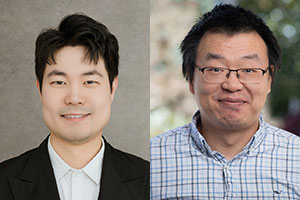
Dr Frank Zhao (left)
Assistant Professor of Physics,
University of Maryland
and
Dr Zhengguang Lu (right)
Assistant Professor of Physics,
Florida State University
The high number and exceptional quality of nominations led the selection committee to award two prizes, recognising both Dr Zhao and Dr Lu for their outstanding contributions to quantum materials research.
Dr Zhao is recognised for his contributions to unconventional superconductivity in layered crystals and their interfaces, including the discovery of emergent time-reversal symmetry breaking superconductivity at twisted cuprate interfaces and a new layered superconductor with one of the highest upper critical fields recorded.
“It is a great honor to be jointly selected for the Lee Osheroff Richardson Prize. A great deal of the credit must go to my mentors, Philip Kim and Joe Checkelsky, who trusted and encouraged me to develop new sample fabrication and measurement techniques even though the payoff was often far off and uncertain. Notably, I really enjoyed pushing the boundary of what is possible with Nicola Poccia, who co-developed the glovebox fabrication techniques with me; as well as Paul Neves, Josh Wakefield, and Dave Graf, whose infectious curiosity and relentless persistence pushed us to see further. Finally, I'm grateful to Pavel Volkov, whose insight can always be relied upon to pierce the fog," commented Dr Zhao.
Dr Lu is recognised for his groundbreaking experimental discoveries of novel topological states and superconductivity in rhombohedral multilayer graphene/hBN heterostructures, using electronic measurements at ultralow temperatures.
“It is a tremendous honor. The prize is especially meaningful to me because it is named after David M. Lee, Douglas D. Osheroff and Robert C. Richardson, whose discovery of superfluidity in helium-3 is one of the landmark achievements of low-temperature physics. Much of my own research also relies on cooling matter to extremely low temperatures to search for emergent quantum states that would otherwise remain hidden. I am very grateful to the prize committee for recognizing our work, and also to my collaborators, and colleagues who have made these discoveries possible." commented Dr Lu.
Dr Zhao began his PhD with Prof Philip Kim at Columbia University in 2012, and completed it at Harvard, where he pioneered cryogenic van der Waals (vdW) stacking and resist-free nanofabrication techniques. He then held a postdoctoral position with Prof Joe Checkelsky at MIT, where he discovered the layered superconductor BaTa2S5. Dr Zhao is now an Assistant Professor at the University of Maryland, where he is building a lab combining single-crystal synthesis with vdW nanofabrication.
Dr Lu completed his PhD at Florida State University and the National High Magnetic Field Laboratory in 2020, after working on magneto-optical spectroscopy of two-dimensional transition metal chalcogenides. From 2021 to 2024, as a Postdoctoral Associate with Prof. Long Ju at MIT, he made a series of landmark discoveries in rhombohedral multilayer graphene, including the discovery of the FQAH effect, for which he received the 2025 McMillan Award. Dr Lu is now an Assistant Professor of Physics at Florida State University and an affiliate of the National High Magnetic Field Laboratory.
Dr Zhao's doctoral work centred on the cuprate superconductor Bi2Sr2CaCu2O8+x (BSCCO), which is highly sensitive to moisture and readily loses oxygen dopants. He overcame this by developing new air-free, cryogenic device fabrication methods that replicate the capability of a cleanroom inside a glovebox. Using atomically thin BSCCO devices, he furthered understanding of a long-standing question about the origin of the Hall voltage reversal near Tc in cuprates, and showed that c-axis twist junctions are sensitive to the d-wave symmetry of the cuprate order parameter.
Most notably, by twisting BSCCO crystals to 45°, Dr Zhao demonstrated emergent time-reversal symmetry breaking superconductivity at the interface, with fractional Shapiro steps and a trainable, zero-field Josephson diode effect. In his postdoctoral work, Dr Zhao discovered BaTa2S5, a bulk layered superconductor with an in-plane upper critical field over 22 times the Pauli limit and evidence of a transition between two distinct superconducting phases, making it a strong candidate for spin-triplet superconductivity.
Since starting his lab at Maryland, Dr Zhao's group has synthesised a new high-k layered dielectric and a novel BiS2-based superconductor.
Dr Lu's most significant accomplishment to date is the discovery of the FQAH effect in a rhombohedral pentalayer graphene/hBN moiré superlattice, a zero-field quantum phase in which electrons self-organise into fractionalised topological states. The discovery was unexpected theoretically, and the material's cleanliness and compatibility with transparent contacts make it a promising platform for interfacing fractionalised topology with superconductivity, with implications for non-Abelian anyonic physics and fault-tolerant quantum computation.
The work drew wide attention, including coverage in Nature News and Quanta Magazine. In the same system, Dr Lu went on to discover a new topological phase, thought to arise from electrons spontaneously forming ordered, crystal-like structures, and contributed to the discovery of chiral superconductivity in rhombohedral graphene, a rare form of unconventional superconductivity that may support Majorana zero modes.
Since starting his own lab at Florida State, Dr Lu has discovered a related chiral superconducting state in hexalayer rhombohedral graphene, work he is preparing for publication.
Matthew Martin, Managing Director at Quantum Design Oxford, said,
“We are delighted to recognise Dr Zhao and Dr Lu with this year's Lee Osheroff Richardson Science Prize. Their work spans new superconducting states at engineered crystal interfaces and the discovery of fractionalised topological order in graphene. We are proud to support both scientists financially and to help share their work with the wider physics community."
The Lee Osheroff Richardson Science Prize promotes and recognises the novel work of young scientists working in the fields of low temperatures and/or high magnetic fields or surface science in North and South America. The Prize is named in honour of Professors David M. Lee, Douglas D. Osheroff and Robert C. Richardson, joint recipients of the Nobel Prize in Physics 1996 for their discovery of superfluidity in 3He.
As part of the prize, Dr Zhao and Dr Lu will share a $15,000 cash prize and additional support to attend a global physics conference.
The 2026 Lee Osheroff Richardson Science Prize selection committee is chaired by Professor Laura Greene (NHMFL and FSU). Committee members include Professor Hae-Young Kee (Toronto University), Professor Collin Broholm (Johns Hopkins University), Professor Paula Giraldo-Gallo (University of Los Andes), Dr Tiancheng Song (Princeton University), and Dr Jeong Min (Jane) Park (Princeton University).
Quantum Design Oxford is aware that there is a critical and often difficult stage for many between completing their PhD and gaining a permanent research position. The company therefore would like to help individuals who are producing innovative work by offering assistance both financially and through promotion of their research work. The prize is named after David M. Lee, Douglas D. Osheroff and Robert C. Richardson who were joint winners of the Nobel Prize in Physics in 1996 for their discovery of superfluidity in 3He.
Copyright © 2026 Quantum Design Oxford

